


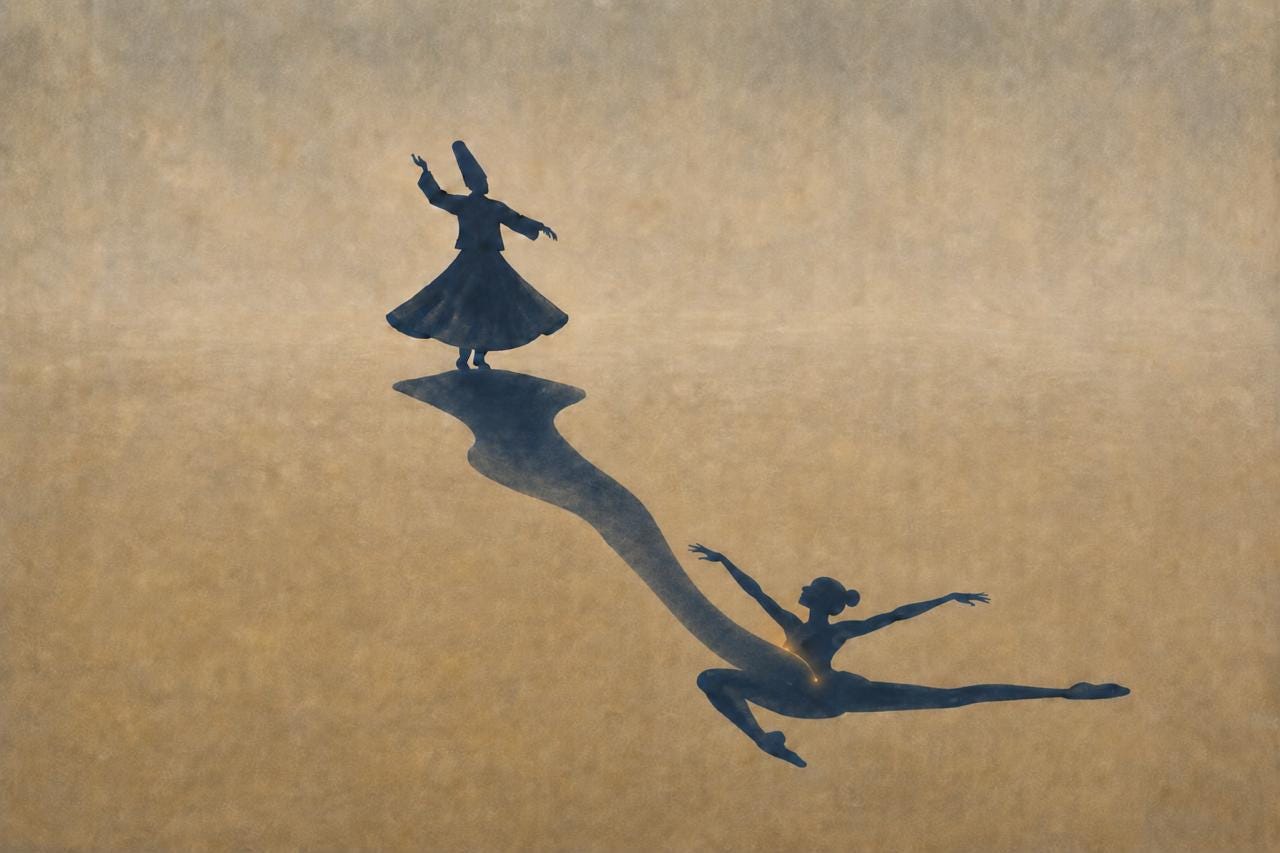
There is a kinship between Sufism and artistic creation that has not been treated with the seriousness and depth it deserves in contemporary Arabic writing: the two converge at points fundamental enough that they can look like two faces of a single coin. The artist carries Sufism within, and for the mystic, creation is inseparable from the experience of gnosis. Both set out from contemplation and the labor of the mind, and both arrive at a state of making and of self-annihilation — whether inwardly and spiritually, as on the Sufi path, or in composition and artistic creativity, as with the writer and the artist. Three major Arab writers have taken up this connection: Adonis, in Sufism and Surrealism, approached the two as visions of the world rather than schools of writing; ʿĀṭif Jūda Naṣr traced the Sufi experience through its poetic symbols in The Poetic Symbol in Sufism; Naṣr Ḥāmid Abū Zayd read Ibn ʿArabī’s imagination with the tools of interpretation in The Philosophy of Hermeneutics. What concerns us here is narrower and more exact: fanāʾ itself — passing away — as a state common to both, kindled in the Sufi and the artist alike at the moment of creation.
The Algerian scholar Saïd Djabelkhir, in his book Sufism and Creativity, holds that both experiences rise out of an existential unease and a longing for the Good and the Absolute:
“Both experiences (Sufism and creativity) begin from an inquietude and a longing for the Good, and for the Absolute that unfolds in the expanse of the self or the external world of what we call the human being—whom Ibn ʿArabī names ‘the Greater World.’ The Sufi and the creator also often share an end: the good of the human being, the realization of his humanity through truth, justice, freedom, peace, and love—by way of aesthetic contemplation in the case of the artist, and by way of religious–gnostic contemplation in the case of the Sufi creator.”
Their paths, however, part: the artist gives that contemplation form as beauty, while the Sufi descends into gnostic contemplation in search of union with the Absolute.
The highest spiritual station the Sufi reaches is union with God and annihilation in Him; the highest creative station the artist reaches is total absorption in the creative process and annihilation in it, dissolving into it until the two become one, and from this a work of art is born.
What drives the Sufi to symbol is what drives the artist to it. Symbol abounds in religion, in Sufism, in poetry and in art because these are fields in which the soul stirs with ideas and feelings that “resist any decisive scientific or mathematical definition,” so whoever would express them gives them bodies drawn from what the senses already know. This is how Zaki Naguib Mahmoud, an Egyptian philosopher committed to positivist reason, explains Ibn ʿArabī’s symbolic method in Tarjumān al-Ashwāq. The movement is the same in both: from the inward outward.
Ibrāhīm al-Kūnī, the Libyan novelist, describes the bond this way:
“A creator cannot create without Sufism—by which I mean the spirit of Sufism and the attempt to pierce through things.”
The painter Walīd Ebeid agrees:
“Art—creativity—springs only from purity, from a Sufi state. Should the artist contend as mere man with men, enmity will overtake him, and news from the heavens will be cut off from him.”
And Henri Bergson arrives at the same thought from another direction:
“The artist’s eye possesses an immense mystical capacity for union with its object.”
The Egyptian broadcaster Wajdī al-Ḥakīm cites the example of his longtime friend, the composer Balīgh Ḥamdī. The secret of his genius, al-Ḥakīm says, was that he dissolved wholly into a melody in the first stages of its making, until he no longer heard or saw the people around him — dissolved in the work of creation and entirely present with it, exactly as in the state of fanāʾ, in which the Sufis lose the human world and live in another: the world of absolute beauty, absolute good, absolute truth.