


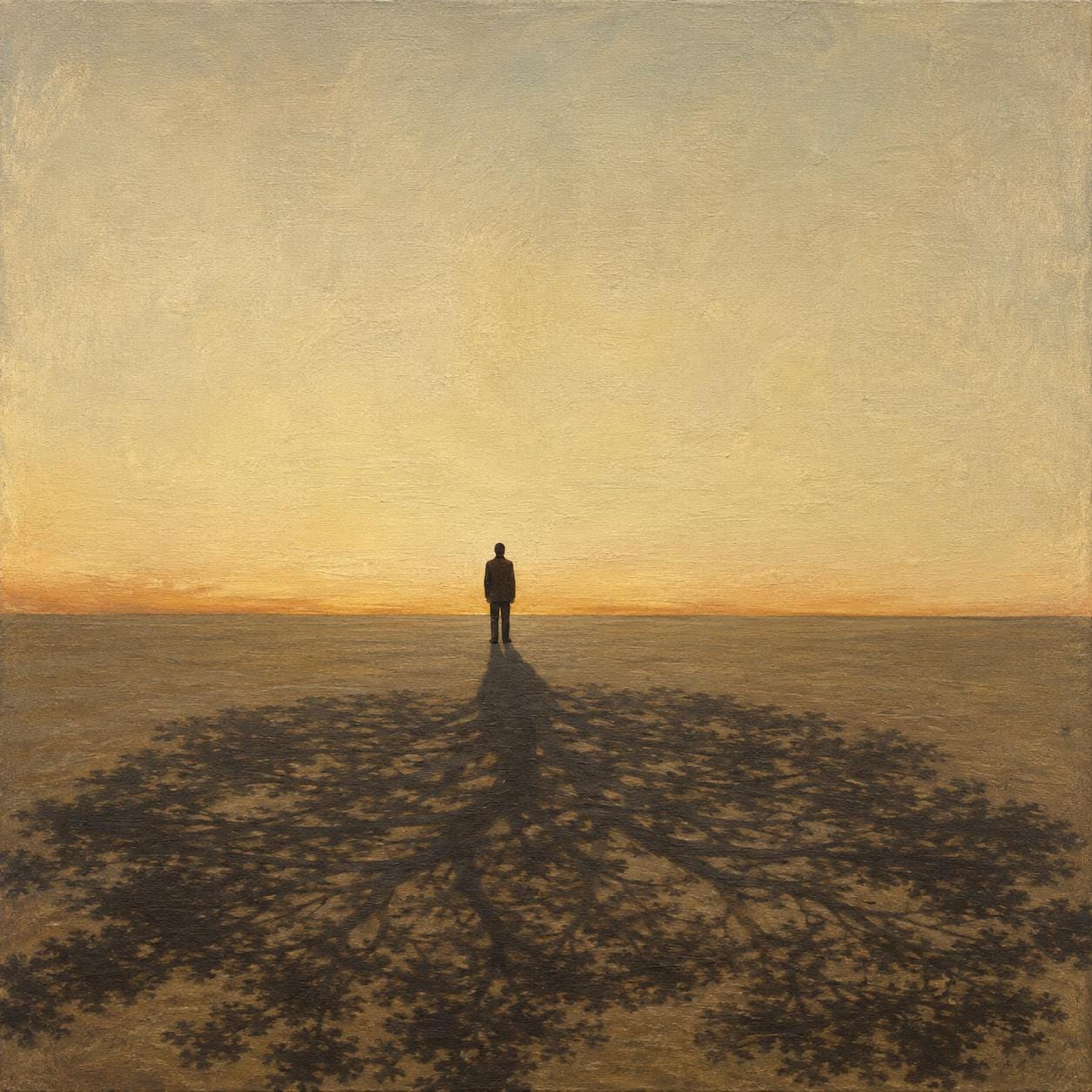
What wears people down is not simply failing at life. Failure is an external event, tied to the hand of fate: a door closes, a chance slips away. It is the suppressed talent, lodged somewhere deep, that finds no outlet through which it can take form, and turns with time from the promise of a wider life into an existential burden.
The trouble begins with a private conviction that something is surging beneath your ribs that has never been granted the right to appear. Some have tried to give that thing free rein and failed, and know the bitterness of it. Others never found a door, or a setting in which to release it. The difference between them is a difference in awareness: some know what they lost, others never learned what they were missing. The effect is identical either way — a creative energy with nowhere to go.
That energy, held down, accumulates over the years like sediment at the bottom of a jar. Nietzsche touched a corner of it in the preface to Thus Spoke Zarathustra, when he made inner chaos the condition for giving birth to a dancing star. But chaos that bears no star does not settle, and latent possibility does not stay suspended forever. Failing to find a form worthy of it, it comes out in a form unworthy of the person — and the ugliness is aesthetic energy, shut in too long. In On the Genealogy of Morals Nietzsche goes further: the slave revolt in morality begins when resentment itself becomes creative and gives birth to values, the resentment of creatures denied the true reaction: the deed itself, and compensating instead with an imaginary revenge. In the case of a suppressed gift, whatever fails to become a mark or beauty goes looking for some other form to live in, and sometimes finds only the dark ones.
You see him in the corner of a café, or in a meeting that has nothing to do with him. He watches the others with something closer to defeat than to envy. He listens to their small achievements, smiles politely, and goes home carrying something he cannot name. He may not know himself which it is: an energy in him that never came out, or a flattering picture he drew to console himself for what he couldn’t do.
Failure in the ordinary sense is another matter entirely. Many of these people have succeeded at most of what they attempted, and still carry a feeling that never leaves them — that the life they lived falls short of the life they believed they deserved. Kierkegaard, in The Sickness unto Death:
the greatest danger, losing oneself, can occur in complete quiet in the world, as though it were nothing at all. And in the same book: by not venturing, it is terribly easy to lose what would be hard to lose in even the most dangerous venture — the self.
Thoreau puts it in a line in Walden:
the mass of men lead lives of quiet desperation.
And Oliver Wendell Holmes, in “The Voiceless”:
Alas for those that never sing, / But die with all their music in them.
Given time, suppressed talent does not stay innocent. It starts as a vague sadness, slowly hardens into irritation with the world and with people and with the days themselves, and ends sometimes in an aversion to success stories, and to anyone who has found a foothold in the light.
The longer the confinement lasts, the more the talent stiffens into a fixed idea about the person who bears it, until they see themselves from the angle of the outcast who was never understood, the one denied a chance at life. And once exclusion and deprivation become the name a person is known by, the energy stops looking for a form to emerge in and folds itself around its wound, and the narcissistic injury becomes the identity. Anyone thinking this way imagines they are observing the prison from outside, when they are one of its bars: each time they turn the deprivation over, they set the picture of themselves more firmly in place, and look for a cure in the very instrument that inflicted the wound.
Suppressed talent runs in reverse. Erich Fromm, in Escape from Freedom:
the more the drive toward life is thwarted, the stronger the drive toward destruction; the more life is realized, the weaker the destructiveness. Destructiveness is the outcome of unlived life.
Freud, in Civilization and Its Discontents, describes sublimation — instinct redirected into a higher cultural channel. Civilization, for Freud, rests on the repression of powerful instincts and the refusal of their satisfaction. Creativity is sublimation that works; neurosis is sublimation that fails. What Freud describes as a mechanism, Ibn al-Qayyim frames as a choice. In al-Wabil al-Sayyib:
if you do not occupy the soul with truth, it will occupy you with falsehood; if the heart is not inhabited by the love of God, it will inevitably be inhabited by the love of created things — so choose one of the two courses for yourself.
And yet this energy is, at bottom, a necessity. Maslow, in Motivation and Personality, makes it the condition of being at peace with oneself:
a musician must make music, an artist must paint, a poet must write, if he is to be at peace with himself; what a man can be, he must be.
Genius tests you before it lets you claim it. In Letters to a Young Poet, Rilke sends the questioner back to himself:
ask yourself, in the stillest hour of your night, whether you must write. If the answer is that you must, then build your life around that necessity. And when the necessity is resisted, it does not die down — it turns feral.
From Kafka’s letter to Max Brod:
a writer who does not write is a monster courting madness, and his life without writing becomes far worse, unbearable, and can only end in insanity.
Talent has another prison, one outside the self. Virginia Woolf, in A Room of One’s Own, imagines Shakespeare’s sister:
any woman born with a great gift in the sixteenth century would certainly have gone crazed or shot herself; a gifted girl who tried to use her gift for poetry would have been so thwarted and hindered by other people, so tortured and pulled apart by her own contrary instincts, that she must have lost her health and her sanity.
The same note sounds in George Eliot’s prelude to Middlemarch:
many Theresas have been born who found no epic life — only a life of mistakes, the offspring of a spiritual grandeur ill-matched with the meanness of opportunity.
And when the outlet is sealed, the body pays the price. Al-Mutanabbi:
when souls are great, the bodies wear themselves out in pursuit of what those souls want.
In the contemporary Arab setting, Mustafa Hijazi, in Social Backwardness, describes how the oppressed person turns inward or identifies with the one who dominates them, so that repressed energy passes from existential possibility into psychological damage.
And in the seventieth saying attributed to the Gospel of Thomas:
if you bring forth what is within you, what you bring forth will save you; if you do not bring forth what is within you, what you do not bring forth will destroy you.
That destruction mostly takes place in dark territory, well out of anyone’s sight, in a nastier form: an emotional coldness no warmth can thaw, and a hard sense of living an unlived life in some parallel world, in the shadow of what might have been.
So: is talent a blessing? It certainly is, for anyone who finds an outlet and a setting for it. And a curse for anyone locked in with it in a prison whose key they are carrying without knowing. The irony is that the genius given to a person to build a life with, and to be of use to others, is the same thing that pulls the life down when it finds no form to take. Confined energy does not vanish; it works away in the depths, and if the silence lasts long enough, it turns against the one who holds it.